Search by allele frequency
Search for datasets containing specific genomic variants using the allele frequency search tool. Allele frequency refers to how common a specific genetic variant is within a population.
This search tool allows you to:
- Identify relevant datasets with your specific genomic variant of interest
- Compare variant frequencies across different populations and research cohorts
- Assess dataset suitability by viewing detailed prevalence data to select the most appropriate datasets for your research
Sign in for enhanced search
Sign in to get comprehensive search results. While you can use this tool without an account, signing in allows you to search and view more details, such as record counts and other metadata, to help you find what you need.
Search by allele frequency
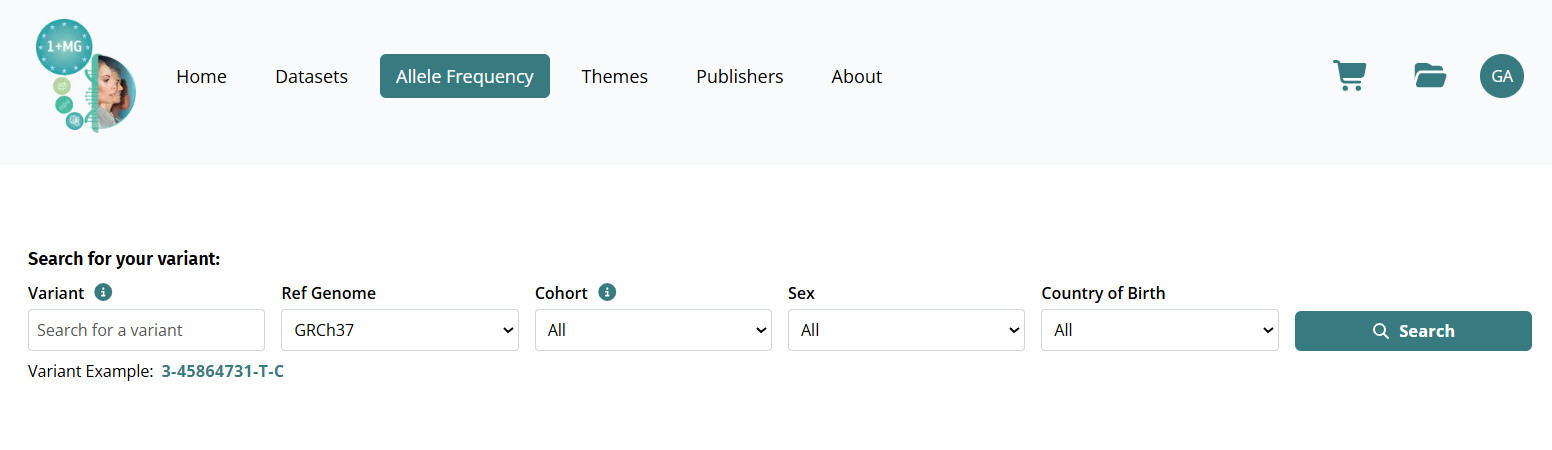
- Select Allele Frequency from the main menu.
-
Enter your search criteria:
- Variant: The full form of the genomic variant, usually represented in the format
chr-position-ref-alt. Example:3-45864731-T-C - Ref Genome: Select the reference genome assembly to use for the search.
- Sex (optional): Filter results by biological sex (Male or Female).
- Country of Birth (optional): Filter results by country of birth using 2-letter ISO country codes.
- Variant: The full form of the genomic variant, usually represented in the format
-
Select Search or press Enter. The search results display dataset information in table format.
Understanding your results
The search results display datasets containing your specified variant in table format. Here's an example of the search result using the allele frequency search tool:
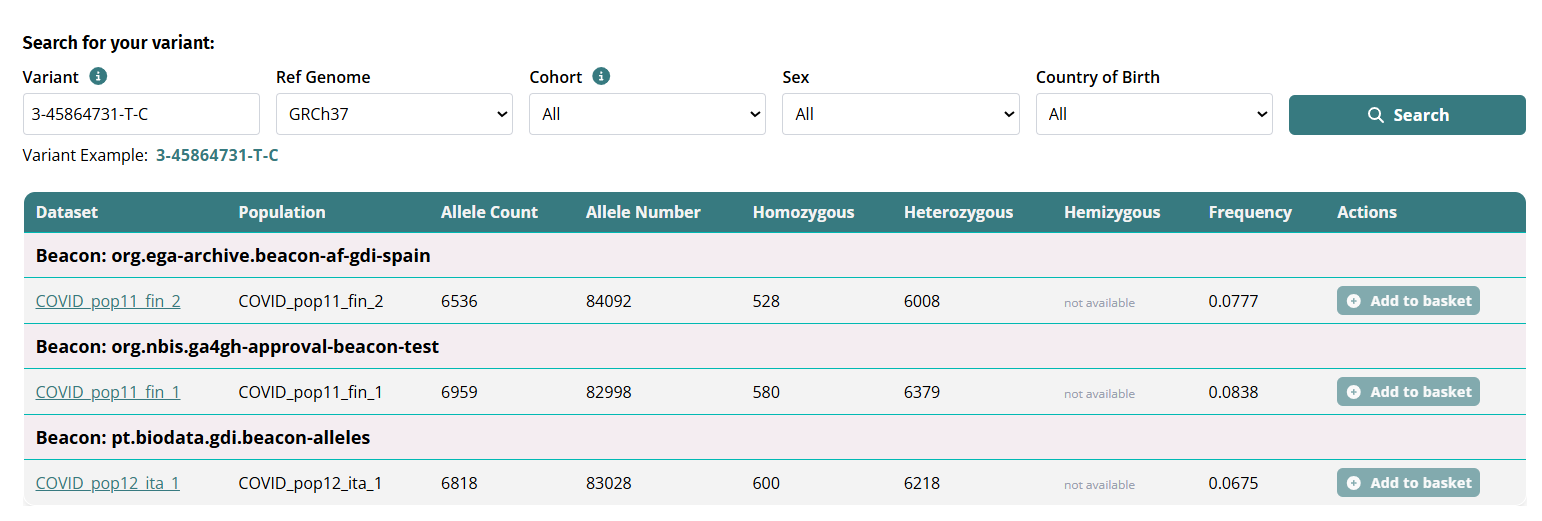
- Dataset: Name and source of the dataset. These are Beacon identifiers—the portal uses Beacon technology to retrieve information about whether genomic databases contain specific variants.
- Population: Population identifier from the dataset (e.g., "FR_M" for French males in GoE format).
- Allele Count: Number of times the variant appears in the dataset.
- Allele Number: Total number of alleles analysed in the dataset for this position.
- Homozygous: Number of individuals with two copies of the variant.
- Heterozygous: Number of individuals with one copy of the variant.
- Hemizygous: Number of individuals with one copy of the variant on a sex chromosome (relevant for an X or Y chromosome).
- Frequency: How common the variant is in that population (as a decimal).
- Actions: Add the dataset to your basket to request access later.