Context and Scope
Business Context
The 1+MG Network operates as a federated network. It does not store data centrally; instead, it orchestrates access between Data Users and Data Holders across National borders.
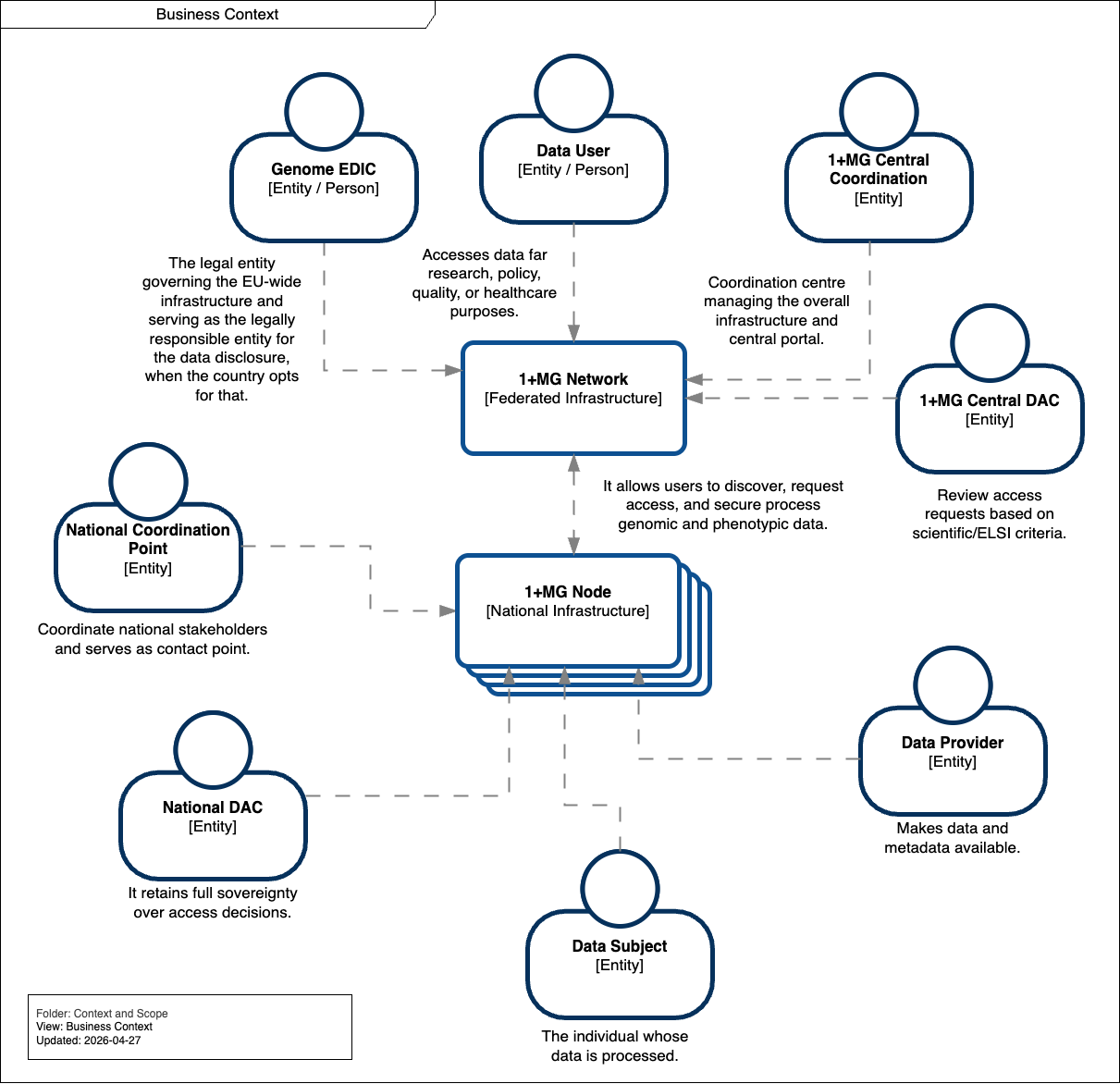
Communication Partners
| Role | Interaction | Input/Output |
|---|---|---|
| Data User | Accesses data for Research, Policy, Quality, or Healthcare purposes.1 | In: Query / WES Workflow Out: Analysis Result / Feasibility Count |
| Data Subject | The individual whose data is processed. | In: Consent / Transparency Info Out: Rights (Object/Withdraw) |
| Helpdesk (Virtual) | Single point of contact for technical and procedural support.2 | In: Incident Ticket Out: Resolution / Guidance |
| 1+MG Central DAC | Reviews cross-border access requests based on scientific/ELSI criteria.3 | In: Access Application Out: Recommendation / Decision |
| National DAC | Reviews access requests for national compliance, retains veto power.3 | In: Central Recommendation Out: Veto / Validation |
| 1+MG CC | Coordination Centre managing the overall infrastructure and central portal.1 | In: aggregated metrics Out: Guidance / SOPs |
| Data Provider | The Controller determining purpose/means and making data available.1 | In: Data Management Plan Out: Dataset Inclusion |
| Data Holder | The entity physically holding the data (Processing/Hosting).1 | In: Encrypted Storage Out: Data Stream to Compute |
| National Coordination Point (NCP) | Coordinates national stakeholders and serves as contact point.1 | In: National Policy Out: Governance Reporting |
| Genome EDIC | The legal entity governing the infrastructure (distinct from the software service). | In: Governance Policies Out: Compliance Audit Reports |
Governance Context
The 1+MG Network operates under a specific governance framework designed to balance cross-border efficiency with national sovereignty.3 It is anchored by the Transnational Code of Conduct to bridge legal gaps.
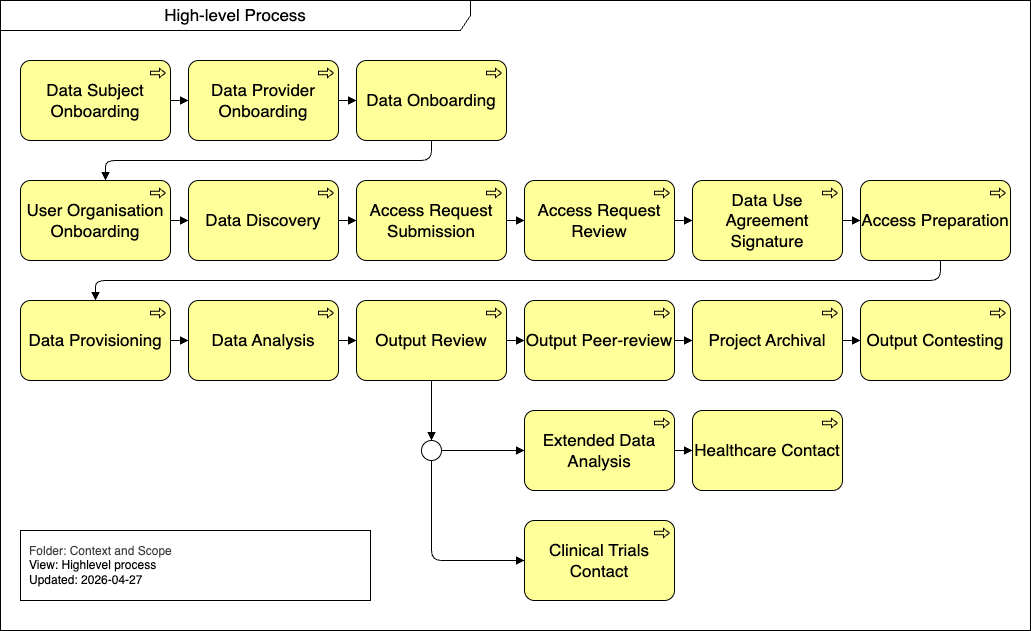
The high-level process: 3
- Data Inclusion
- Data Provider Onboarding: Registering and validating organizations that supply data to the network.
- Data Subject Onboarding: Managing patient/subject consent and transparency for their data inclusion.
- Data Onboarding: Ingesting, harmonizing, and securely storing datasets within a node.
- Data Access
- User Organisation Onboarding: Registering and verifying user organizations applying for data access.
- Data Discovery: Enabling users to search and identify relevant datasets across the federated network.
- Access Request Submission: Allowing users to submit detailed applications to access specific datasets.
- Access Request Review: Central and National DACs evaluating the request based on scientific, ethical, and compliance criteria.
- Data Use Agreement Signature: Formalizing the data access agreement between the user and data providers.
- Access Preparation: Setting up the secure processing environment and configuring permissions.
- Data Use
- Data Provisioning: Making the requested data securely available to the authorized user's environment.
- Data Analysis: Users executing analytical workflows on the provisioned data within the secure environment.
- Extended Data Analysis: Requesting additional time or resources to complete ongoing analyses.
- Clinical Trial Contact: Re-contacting data subjects for potential participation in clinical trials, if consented.
- Output Review: Reviewing analysis results to ensure no sensitive or re-identifying information is exported.
- Output Peer-review: Academic or scientific evaluation of the final research outputs.
- Project Archival: Securely closing the project, archiving logs and the compute environment.
- Output Contesting: Handling disputes regarding denied outputs or access decisions.
- Healthcare Contact: Informing data subject's healthcare provider of actionable incidental findings or requesting for further information.
However, evaluations highlight significant existing fragmentation:
-
National Silos: Some infrastructures risk becoming silos due to local language requirements or strict national certification demands for compute environments.4
-
Ethics Fragmentation: There is currently no EU-wide harmonised ethical approval procedure; decisions are made on a case-by-case basis.4
-
Single Access Principle: Users submit one application through a central portal, which is reviewed by a central 1+MG Data Access Committee (DAC).
-
National Veto: While the central DAC provides a recommendation/decision, the ultimate decision remains with the Data Providers/National DACs, who retain a right of veto.
-
Controller Relationships:
- Data Provider: Acts as Controller for data inclusion, storage, and making data available.
- Data User: Acts as Controller for the processing of data for their specific research purpose.
- 1+MG Network: Acts as Processor providing the secure environment and tools.
- 1+MG CC/DAC: Acts as Joint Controller (with Data Providers) for the data disclosure process (provision of access).
EHDS Alignment
The 1+MG Network is designed to align with the European Health Data Space (EHDS). In the context of EHDS, 1+MG nodes and the central infrastructure aim to function as an Authorised Participant in the HealthData@EU infrastructure.3
- Data Holder Role: 1+MG nodes fulfill the obligations of "Data Holders" under EHDS (making data available).
- Secure Processing: The 1+MG Secure Processing Environments (SPEs) align with EHDS requirements for Secure Processing Environments.